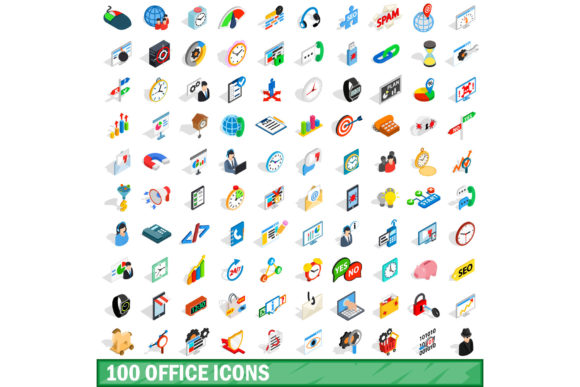
100 Office Icons Set, Isometric 3d Style
In a digital landscape saturated with flat design and minimalist aesthetics, the 100 Office Icons Set, Isometric 3d Style offers a refreshing visual narrative that bridges the gap between technical precision and creative depth. This collection is not merely a bag of graphical elements; it represents a sophisticated approach to visual communication in modern workflows. For professionals, entrepreneurs, and creators who need to convey complex business concepts quickly, these icons provide a three-dimensional context that flat symbols often lack.
The shift toward isometric design has been driven by a growing demand for clarity and immersion. When users interact with dashboards, presentations, or marketing materials, they respond better to visuals that mimic real-world spatial relationships. The 100 office icons set in isometric 3d style for any design vector illustration addresses this need directly, offering a versatile toolkit that enhances user experience while maintaining professional polish. Whether you are designing a startup pitch deck, an educational module, or a corporate intranet interface, these assets provide the necessary depth to make your content stand out without overwhelming the viewer.
The Evolution of Visual Communication in Business
Design trends have always reflected the technological and cultural zeitgeist of their time. We moved from skeuomorphism, which tried to replicate physical objects as closely as possible, to flat design, which prioritized speed and scalability. Today, we are seeing a resurgence of dimensionality through isometric projections. This style retains the clean lines of flat design but adds the crucial element of volume, allowing designers to create scenes that feel structured yet dynamic.
The relevance of the 100 Office Icons Set, Isometric 3d Style lies in its ability to adapt to this evolving preference. Modern businesses are increasingly reliant on remote collaboration tools, cloud-based project management systems, and data visualization platforms. These environments require icons that can represent abstract concepts like "cloud storage," "team collaboration," or "data analysis" in a way that feels tangible. Isometric icons achieve this by providing a consistent angle and perspective that mimics a blueprint or a model, making abstract processes easier to understand at a glance.
Furthermore, the rise of the gig economy and freelance work has democratized high-quality design. Freelancers and small business owners no longer need to commission custom illustrations for every project. A comprehensive set like this allows independent creators to produce work that rivals large agencies. By utilizing pre-designed, high-fidelity vectors, a solo entrepreneur can build a cohesive brand identity across websites, social media, and printed materials with remarkable efficiency.
Why Isometric Design Resonates with Modern Audiences
Human brains are wired to process spatial information efficiently. When we see a 3D object, even one rendered in 2D space, our eyes naturally trace the edges and surfaces to understand its form. This cognitive shortcut makes isometric icons particularly effective for instructional content. In an era where attention spans are shorter than ever, the ability to communicate a message instantly is paramount.
Consider a software onboarding screen. A flat icon of a "user profile" might be recognizable, but an isometric version showing a character interacting with a device adds a layer of storytelling. It invites the user into the scene rather than simply labeling a function. The 100 office icons set in isometric 3d style leverages this psychological advantage, turning mundane administrative tasks into engaging visual experiences.
This style also aligns perfectly with current trends in web development and UI/UX design. As screens become higher resolution and browsers more capable of rendering complex graphics, there is less need to sacrifice detail for performance. Users now expect rich, interactive interfaces. Isometric illustrations offer a way to add personality and warmth to corporate applications, breaking the monotony of standard grid layouts. They signal that a brand cares about the details and invests in quality.
Practical Applications Across Industries
The versatility of this icon set extends far beyond simple decoration. Professionals in various sectors can leverage these assets to solve specific communication challenges. For marketers, these icons serve as powerful anchors in infographics and whitepapers, helping to break up dense text and guide the reader's eye through complex arguments. The 3D effect ensures that key data points pop, increasing the likelihood that the audience will retain the information presented.
Educators and trainers find immense value in using isometric visuals for e-learning modules. When explaining a workflow or a system architecture, a static diagram can be dry. However, a scene built from the 100 Office Icons Set, Isometric 3d Style can animate the flow of information. Imagine a presentation on supply chain logistics where trucks, warehouses, and documents are depicted in a unified 3D style, creating a cohesive world that helps students visualize the entire process.
For developers and tech startups, these icons are essential for building landing pages and product demos. Startups often struggle to differentiate themselves in crowded markets. A unique, high-quality visual identity can be the deciding factor for investors or early adopters. Using a consistent isometric theme across all touchpoints creates a sense of professionalism and reliability. It suggests that the company is organized, forward-thinking, and attentive to the user journey.
Technical Flexibility and Workflow Integration
One of the most critical aspects of any design asset is its compatibility with existing workflows. The 100 office icons set in isometric 3d style for any design vector illustration excels here, offering a robust range of file formats including JPG, EPS, AI, PSD, and PNG. This variety ensures that whether you are working in Adobe Illustrator, Photoshop, or a vector-based prototyping tool, you have the right format at your fingertips.
- Vector Formats (AI, EPS): These are indispensable for designers who need to scale their work. You can resize an icon from a tiny favicon to a massive billboard poster without losing any sharpness. This scalability is vital for responsive web design, where images must adapt to various screen sizes seamlessly.
- Raster Formats (JPG, PNG): For quick deployment in email campaigns, social media posts, or basic web headers, these formats offer immediate usability. High-resolution PNGs with transparent backgrounds allow for easy layering over different color schemes and textures.
- Layered Files (PSD): The inclusion of Photoshop files provides maximum control. Designers can isolate specific layers, adjust colors, modify shadows, or rearrange elements to fit a specific brand guideline. This flexibility transforms a static icon into a customizable component of a larger design system.
The availability of these diverse formats means that teams can collaborate more effectively. A graphic designer might edit the master vector file in Illustrator, while a web developer extracts the optimized PNGs for the site, and a marketer uses the JPGs for a newsletter. This seamless handoff reduces friction and accelerates project timelines.
Building a Cohesive Brand Identity
Consistency is the backbone of strong branding. When a brand uses a mix of styles—some flat, some realistic, some cartoonish—it creates visual noise that confuses the audience. The 100 Office Icons Set, Isometric 3d Style solves this problem by providing a unified aesthetic language. Every icon shares the same lighting, perspective, and shading logic, ensuring that the final composition looks intentional and polished.
This consistency is particularly important for businesses expanding their digital presence. As companies grow, they often acquire new departments or launch new products. Having a library of compatible icons allows them to maintain their visual identity across these expansions without needing to redesign everything from scratch. It acts as a visual anchor, grounding the brand in a recognizable style that customers can trust.
Moreover, the isometric style allows for subtle customization. While the base set is uniform, the neutral tones and geometric nature of the icons make them easy to recolor to match specific brand palettes. This adaptability ensures that the icons do not clash with existing logos or typography, but rather enhance them. The result is a holistic design system where every element works in harmony.
Future-Proofing Your Design Assets
As we look toward the future of digital interaction, the line between 2D and 3D continues to blur. With the advent of augmented reality (AR) and virtual reality (VR), spatial design is becoming increasingly relevant. Even if your current projects do not involve AR, investing in isometric assets prepares you for a future where 3D understanding is a standard skill. The principles behind isometric design translate well to 3D modeling and animation, making this set a valuable stepping stone for creators looking to expand their technical repertoire.
Additionally, the trend toward personalized and immersive user experiences shows no sign of slowing down. Users want to feel connected to the content they consume. Isometric icons offer a way to inject humanity and structure into digital spaces, making technology feel less cold and more accessible. By adopting this style now, businesses position themselves as innovators who understand the shifting expectations of their audiences.
In conclusion, the 100 office icons set in isometric 3d style for any design vector illustration is more than just a collection of graphics; it is a strategic tool for modern communication. It combines aesthetic appeal with practical utility, offering a solution that fits seamlessly into the workflows of today's professionals. Whether you are refining a corporate website, creating educational content, or building a brand from the ground up, this set provides the visual foundation needed to tell your story effectively. Embracing this style is an investment in clarity, engagement, and long-term brand equity.