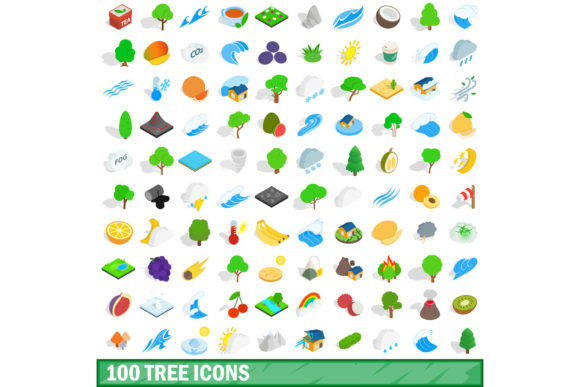
100 Tree Icons Set, Isometric 3d Style
When you are designing a website, creating an infographic, or building a mobile app, the visual language you choose can make or break the user experience. This is where the 100 Tree Icons Set, Isometric 3d Style becomes a vital asset for designers and developers alike. Unlike flat, two-dimensional illustrations that have become somewhat generic, isometric icons add depth, dimension, and a modern architectural feel to any project. They transform simple concepts into tangible objects that users can intuitively understand.
However, simply downloading a pack of vector illustrations is not enough. Many creators fall into the trap of assuming that because an image looks good in a preview, it will function perfectly in their final layout. Before you commit to using this specific set, it is crucial to understand what makes these assets valuable and how to avoid common pitfalls that often lead to pixelated logos, inconsistent designs, or legal headaches down the road.
Understanding the Value of Isometric Depth
The primary appeal of the 100 tree icons set in isometric 3d style lies in its ability to create a cohesive visual narrative without overwhelming the viewer. Isometric projection allows you to depict three-dimensional objects on a two-dimensional plane without perspective distortion. For a designer, this means you can build entire environments—like a forest ecosystem, a city park, or an ecological dashboard—that look structured and professional.
Beginners often mistake "3D" for "complex." In reality, high-quality isometric vectors are built on precise grids. When you use a well-constructed set like this one, every tree maintains the same angle and scale, ensuring your design remains balanced. If you try to mix random 3D trees with different perspectives, the result looks amateurish and disjointed. The strength of this specific collection is that all 100 variations share a unified geometric logic.
Pitfalls in File Format Selection
One of the most frequent errors I see professionals make involves ignoring the file formats included in the package. The description lists JPG, EPS, AI, PSD, and PNG. While having options sounds great, it can also be confusing if you do not know which file to open for which task.
- Using JPGs for Logo Design: A common mistake is dragging a JPG version of a tree icon into a logo design software. JPGs are raster images, meaning they are made of pixels. If you try to scale them up for a billboard or even a large header, they will become blurry and jagged. Always start with the AI or EPS files for any work requiring scalability.
- Ignoring Layer Structure in PSD: The Photoshop (PSD) files are powerful, but only if you respect their layer organization. Many users flatten the image immediately after opening it. This destroys the ability to change the color of the trunk versus the leaves later. Keep the layers intact if you plan to customize the palette.
- Confusing Vector and Raster: Do not assume that just because a file says "PNG," it is scalable. High-resolution PNGs are excellent for web use, but they still cannot be resized infinitely without quality loss. Reserve them for final exports, not for the editing phase.
The Cost of Low-Quality Vectors
Choosing the wrong file type affects more than just aesthetics; it impacts your efficiency and cost. If you spend hours designing a brochure using low-resolution rasters, and then realize you need to print it at a larger size, you may have to restart the entire project. This wasted time translates directly into lost revenue. By starting with the editable AI (Adobe Illustrator) or EPS versions provided in the set, you ensure that every element—from the smallest leaf detail to the largest branch—is mathematically perfect.
Consistency in Application
Another area where projects often fail is the lack of consistency in application. You might download the 100 tree icons set, isometric 3d style and find yourself tempted to pick the "cutest" tree for your homepage and the "tallest" tree for your footer. While variety is good, mixing styles that do not align with your brand's tone can confuse your audience.
Consider a scenario where a small business owner uses these icons for an eco-friendly product line. If they select a dark, moody pine tree for the packaging and a bright, cartoonish sapling for the social media ads, the brand identity fractures. Users subconsciously notice these inconsistencies, which erodes trust. To avoid this, define a style guide before you begin. Decide if you want the "forest" theme to represent growth, stability, or nature, and stick to the subset of icons that best communicates that message.
Color Customization Mistakes
Isometric art relies heavily on lighting and shadow to create depth. A frequent error occurs when users apply flat colors over these complex gradients without understanding the light source. If the original icon assumes light is coming from the top-left, but you recolor the shadows to be darker than the highlights, the object will look broken or "inside out."
To correct this, always sample the existing color values from the AI or EPS files rather than guessing new hex codes. Look at the highlight, mid-tone, and shadow layers separately. If you need to match a brand color, adjust the hue of the mid-tones first, then carefully shift the shadows and highlights to maintain the illusion of volume. This subtle attention to detail is what separates a professional design from a basic clipart assembly.
Evaluating Licensing and Usage Rights
Before you incorporate these assets into a commercial product, such as a client's website or a physical merchandise line, you must verify the licensing terms. It is a common misconception that purchasing a vector set grants unlimited rights for every possible use. Some licenses restrict the number of end products or prohibit resale of the raw files.
If you are a freelancer working for multiple clients, ensure the license covers multi-project usage. Conversely, if you are a hobbyist, you might not need a premium commercial license, but you should still check if attribution is required. Ignoring these details can lead to legal disputes that are far more expensive than the cost of the icon set itself. Always read the fine print regarding modification rights; some vendors allow you to change colors but forbid altering the shape or structure of the isometric grid.
Practical Steps for Better Results
To get the most out of the 100 tree icons set in isometric 3d style, follow a structured workflow. First, organize your folders by separating the vector sources from the raster exports. Second, experiment with grouping icons to create scenes. Since the set includes 100 variations, you have the freedom to mix different species of trees, adding bushes or rocks to create a dynamic landscape.
Third, test your icons across different devices. An isometric icon might look stunning on a desktop monitor but could lose detail on a mobile screen due to compression algorithms. Export your final assets at 2x resolution (retina) to ensure crisp rendering on high-density displays. Finally, keep your source files safe. Because the AI and PSD files contain editable data, backing them up ensures you can revisit and update your designs years later without losing quality.
By avoiding these common traps and respecting the technical nuances of isometric design, you unlock the full potential of this versatile asset library. Whether you are a marketer crafting a campaign or a developer building a green-tech platform, the right choice of tools makes the difference between a good design and a great one.