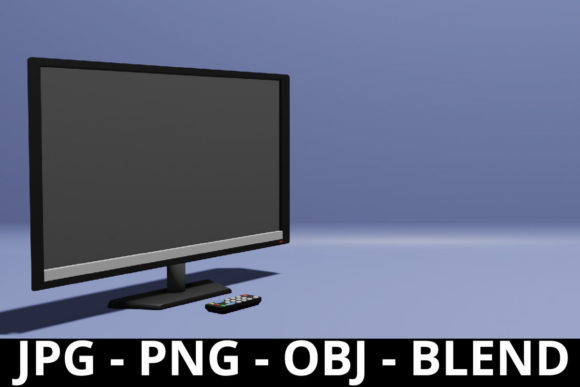
3D Rendering Television for Your Design
In the rapidly evolving landscape of digital visualization, the demand for high-quality assets has never been higher. Whether you are an interior designer crafting a photorealistic living room, a motion graphics artist creating a broadcast sequence, or a product developer showcasing a new electronic device, the quality of your visual output depends heavily on the fidelity of your source materials. 3D Rendering Television for Your Design represents a critical component in this workflow, offering a versatile solution that bridges the gap between raw geometry and finished imagery.
This article explores the utility of 3D rendered television assets, specifically those available in comprehensive ZIP folders containing JPG, PNG, BLEND, and OBJ formats. We will evaluate who benefits most from these tools, the technical advantages they offer, and the practical considerations required before integrating them into your project.
Understanding the Asset: What is Included?
When professionals refer to a 3D rendering television with remote, they are typically discussing a complete package designed for immediate integration into various software environments. These assets are not merely static images; they are fully modeled objects capable of manipulation within a three-dimensional space.
A standard distribution for this type of media usually includes:
- JPG and PNG Files: High-resolution raster images suitable for quick mockups, presentations, or background textures where editing the 3D model is unnecessary.
- BLEND Files: Native Blender files that allow designers to modify lighting, camera angles, and material properties directly within the Blender ecosystem.
- OBJ Files: Universal geometry files compatible with almost any 3D modeling software, including Maya, 3ds Max, Cinema 4D, and Unreal Engine.
The inclusion of a remote as part of the set adds a layer of realism essential for lifestyle shots. It transforms a generic screen into a functional piece of home entertainment, suggesting usage and context. The object is typically modeled with modern aesthetics, featuring thin bezels, LCD or LED panel technology, and a sleek black finish that fits contemporary interior design trends.
Why Professionals Choose Rendered TV Assets
The decision to utilize pre-made 3D models rather than modeling a television from scratch is driven by efficiency and accuracy. For individuals researching 3D rendering television for your design needs, the primary motivation is often time management. Creating a realistic display with accurate reflections, emissive screens, and proper physical proportions can be labor-intensive. Pre-rendered assets eliminate this barrier.
Furthermore, these assets provide consistency. In a series of images depicting different rooms—such as a modern living room, a corporate office, or a hotel suite—the television must look identical in every shot to maintain brand or stylistic integrity. Using a single, high-quality model ensures that the aspect ratio, color temperature of the screen, and frame thickness remain uniform across all deliverables.
Benefits of a Multi-Format ZIP Folder
The versatility of receiving a ZIP folder containing multiple file types is a significant advantage for complex workflows. It allows a user to start with a low-fidelity JPG for a client presentation and then switch to the BLEND or OBJ file when a final, high-definition render is required.
This flexibility supports various stages of production:
- Conceptualization: Use the PNG or JPG to quickly place a television into a floor plan or mood board without needing heavy 3D software.
- Development: Import the OBJ or BLEND file into your scene to adjust lighting setups, add environmental reflections, or animate the remote control.
- Final Output: Render the scene in HD or 4K resolution, ensuring the screen displays crisp graphics suitable for broadcast or movie post-production.
This approach reduces the need for external plugins or complex texturing workflows, as the asset often comes with optimized UV mapping and ready-to-use shaders.
Considerations and Tradeoffs
While highly efficient, using pre-made 3D assets requires careful evaluation. One of the primary tradeoffs is the lack of total control over the initial geometry. If a specific design requires a unique curvature or a non-standard size that deviates significantly from the provided model, modifying the mesh might be more difficult than building it from scratch.
Additionally, the realism of the final image relies heavily on how well the asset integrates with the environment. A smart TV model with a perfect screen emission will still look fake if the lighting in the surrounding room does not account for the glow of the display. Users must possess a solid understanding of light bounces, ambient occlusion, and screen reflection physics to ensure the electronic device feels grounded in the scene.
Another consideration is file compatibility. While OBJ is universal, BLEND files require the recipient to have Blender installed. If a team member uses a different software package, the native file may need conversion, which can sometimes result in minor texture or modifier errors.
When This Solution Fits Best
The 3D rendering television with remote is an ideal choice for interior visualization projects. When designing a modern house or renovating a living room, the focus is often on spatial relationships and furniture placement. A high-quality TV model helps clients visualize how a large display impacts the scale of the room.
It is also strongly suited for marketing materials. Companies launching a new home entertainment system or a streaming service can use these assets to create consistent promotional imagery. The ability to swap out the screen content easily (using the blank or customizable screen surface) allows for dynamic advertising without reshooting or re-rendering the entire scene.
Motion graphics artists working on graphic overlays or news broadcasts also benefit from these assets. They can import the monitor into a 3D scene, animate a camera fly-through, and composite the screen with custom video feeds, creating a seamless visual narrative.
Alternatives to Consider
If your project involves extreme customization, such as a futuristic interface or a non-standard shape, a pre-made model may limit your creative vision. In such cases, modeling a television from scratch using reference blueprints might be necessary. Similarly, if your workflow is strictly 2D-based and does not require depth or perspective changes, purchasing a library of photorealistic photos of televisions might be more cost-effective than managing 3D files.
For users focused solely on the screen content rather than the hardware, some workflows prefer using "screen replacement" techniques where a flat plane is mapped with a video file, bypassing the need for a full 3D chassis entirely. However, this sacrifices the ability to capture reflections on the bezel or the physical volume of the device.
Decision-Making Insights
To determine if this asset aligns with your goals, ask yourself the following questions regarding your current project requirements:
- Do I need to change the camera angle? If yes, a 3D model (OBJ/BLEND) is essential. Static images will not work.
- Is the lighting dynamic? If the scene involves moving lights or changing times of day, the 3D model's material properties must react correctly to the environment.
- What is my deadline? If time is tight, the ZIP folder format offers an immediate solution compared to modeling and texturing from zero.
- Do I need the remote? If the story requires interaction, having the remote included in the pack saves significant setup time.
Ultimately, 3D rendering television for your design serves as a powerful tool for enhancing visual communication. By providing a balance of convenience, high-fidelity geometry, and format versatility, it empowers creators to produce professional-grade visuals for interior spaces, digital interfaces, and entertainment media. Whether you are working on a house renovation proposal or a movie set extension, selecting the right asset can streamline your process and elevate the final output.