100 Bakery Icons Set, Isometric 3d Style: A Practical Evaluation for Designers
In the competitive landscape of digital design, visual consistency is often the difference between a project that feels professional and one that appears amateurish. When creating content for bakeries, cafes, or food delivery applications, designers frequently face the challenge of sourcing assets that are both visually appealing and technically versatile. The 100 Bakery Icons Set, Isometric 3D Style emerges as a comprehensive resource designed to address these specific needs. This collection offers a distinct aesthetic approach that moves beyond flat, two-dimensional graphics, providing depth and realism through an isometric perspective.
Understanding the nuances of this icon set requires looking at more than just the number of items included. It involves evaluating how the isometric 3D style interacts with modern UI/UX trends, how the provided file formats support various workflows, and whether this specific volume of assets aligns with the scope of your current project. For professionals aged 20 to 50 who manage complex design systems, the decision to adopt this resource hinges on its adaptability, quality, and the specific problems it solves compared to alternative illustration methods.
The Distinctive Nature of Isometric 3D in Food Illustration
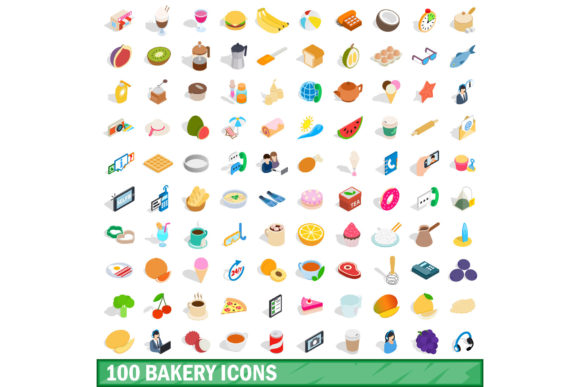
The term "isometric" refers to a method of graphic representation where three-dimensional objects are drawn with parallel lines, maintaining a consistent scale without vanishing points. When applied to a 100 Bakery Icons Set, Isometric 3D Style, this technique transforms simple symbols into miniature, tangible scenes. Unlike flat icons, which rely on minimalism and abstraction, isometric designs offer volume, texture, and spatial context. In the context of bakery products, this allows a designer to showcase the layers of a cake, the flakiness of a croissant, or the glaze on a donut with a level of detail that flat vector art often struggles to convey effectively.
This style is particularly effective because it bridges the gap between abstract data visualization and photorealistic imagery. It provides enough detail to be instantly recognizable as a specific pastry while retaining the clean lines necessary for scalable web graphics. The "3D" aspect here does not necessarily imply fully rendered, ray-traced models; rather, it suggests a constructed depth that makes the icons feel like physical objects sitting on a surface. This adds a playful yet sophisticated tone to interfaces, making it ideal for menu boards, promotional banners, and mobile application dashboards.
Why Volume Matters: The Advantage of a 100-Item Collection
Selecting an asset pack based solely on the quantity of items can be misleading, but a set containing 100 unique bakery icons offers significant strategic advantages for larger projects. Many standard icon packs provide only 10 to 20 core items, forcing designers to either purchase additional packs or create custom illustrations to fill gaps. With a comprehensive collection, designers gain access to a wide spectrum of bakery categories, including breads, pastries, beverages, utensils, and seasonal treats.
This breadth reduces the need for external research or commissioning custom work, streamlining the production timeline. Furthermore, having a unified set ensures stylistic consistency across an entire brand identity. If a designer mixes and matches icons from different sources, even within the same style category, slight variations in lighting, angle, or line weight can break the immersion of the user interface. A single-source solution guarantees that every element, from a coffee cup to a pie chart representing sales, shares the exact same geometric rules and shading logic.
Format Versatility and Technical Integration
The utility of any design resource is heavily dependent on the file formats it supports. The availability of JPG, EPS, AI, PSD, and PNG files within this set addresses the diverse technical requirements of different stages in the design workflow. Each format serves a specific purpose, allowing the 100 Bakery Icons Set, Isometric 3D Style to integrate seamlessly into various software environments.
- AI and EPS: These vector formats are essential for scalability. They allow designers to resize icons from a tiny favicon to a massive billboard without losing resolution. More importantly, they preserve the editability of the artwork. Users can ungroup elements, change colors to match brand guidelines, or modify specific details of the isometric structure directly within Adobe Illustrator or CorelDRAW.
- PSD: The Photoshop document format is crucial for raster-based workflows. It typically includes layer comps and smart objects, enabling advanced manipulation such as adding shadows, adjusting lighting effects, or compositing the icons into complex background scenes. This is particularly useful for marketing materials that require a high degree of artistic control.
- PNG: Portable Network Graphics provide lossless compression with transparency. This is the go-to format for web development and app prototyping. PNG versions ensure that the icons render crisply on high-density displays (Retina screens) without the need for further processing.
- JPG: While less flexible due to lack of transparency, JPG files are optimized for quick previewing and embedding in documents where file size is a primary concern over editability.
This multi-format approach contrasts sharply with many modern icon libraries that offer only SVG or WebP. By providing legacy and industry-standard formats alongside modern ones, this set ensures compatibility with older design tools and broader client requirements.
Evaluating Tradeoffs: Isometric vs. Alternative Styles
While the 100 Bakery Icons Set, Isometric 3D Style offers compelling benefits, it is not the universal solution for every design challenge. Understanding when to use this style versus alternatives is critical for making an informed decision. The primary tradeoff lies in complexity and file weight. Isometric 3D icons are inherently more detailed than flat or line-art icons. Consequently, they require more cognitive load for the viewer to process and often result in larger file sizes, which can impact page load speeds if not optimized correctly.
For minimalist interfaces, such as dashboard analytics or utility apps where clarity and speed are paramount, flat design or thin-line vectors might be superior. Flat icons reduce visual noise and allow the content itself to take center stage. In contrast, isometric styles draw attention to the graphics themselves. Therefore, this set is best suited for landing pages, e-commerce product showcases, educational materials, and branding campaigns where engagement and visual storytelling are the goals.
Comparing Custom Illustrations vs. Pre-Made Sets
Another common comparison is between using a pre-made set like this and commissioning custom illustrations. A custom approach offers absolute uniqueness, ensuring that no other brand uses the exact same assets. However, it comes with a significantly higher cost and longer turnaround time. A 100 Bakery Icons Set provides immediate access to a cohesive library at a fraction of the price. For startups, small businesses, or rapid prototyping phases, the pre-made set is often the most pragmatic choice. It allows teams to visualize concepts quickly without waiting weeks for a freelance illustrator to deliver a custom batch of pastries.
However, there is a limitation to pre-made sets: they may not perfectly match a brand's specific color palette or unique product offerings. While the EPS and AI formats allow for color customization, the underlying geometry of the icons is fixed. If a bakery specializes in a very niche type of pastry not represented in the 100-item collection, the designer will still need to supplement the set with custom drawings. In such cases, the set serves as a foundation rather than a complete solution.
Strategic Application and Decision Factors
To determine if this resource fits your project, consider the intended medium and the target audience. The isometric 3D style has a broad appeal, often resonating well with younger demographics who are accustomed to rich, interactive digital environments. It works exceptionally well for mobile applications where screen real estate is limited but visual interest is high. The "tactile" nature of the icons can entice users to click, potentially increasing conversion rates for food ordering platforms.
Conversely, if the design direction leans towards luxury, high-end editorial, or serious corporate reporting, the playful nature of 3D bakery icons might clash with the desired tone. In those scenarios, a monochromatic or grayscale vector set might be more appropriate. Additionally, the sheer volume of 100 icons implies a need for organization. Designers must be prepared to categorize and select only the relevant assets to avoid cluttering their workspace or their final deliverables.
The versatility of the included formats also dictates the workflow efficiency. Teams working in a hybrid environment—where some members use vector software and others work in layout programs like InDesign or Photoshop—will find the inclusion of PSD and AI files invaluable. It eliminates the friction of converting files and re-rendering assets, saving valuable hours during the production phase.
Making the Final Choice
The decision to utilize the 100 Bakery Icons Set, Isometric 3D Style ultimately depends on balancing aesthetic goals with practical constraints. If your project requires a cohesive, engaging visual language that elevates food-related content without resorting to expensive photography or custom illustration, this set provides a robust starting point. Its strength lies in the combination of a substantial quantity of assets, a trendy and versatile 3D aesthetic, and a comprehensive range of editable file formats.
However, it is important to acknowledge that no single asset pack is perfect. Designers should evaluate their specific needs against the limitations of pre-made geometry and potential file size implications. For projects demanding extreme minimalism or highly specialized branding, supplementary custom work may still be necessary. Yet, for the majority of commercial and creative endeavors involving bakery themes, this collection offers a balanced, high-value solution that accelerates the design process while maintaining a professional standard.
By carefully considering the strengths of the isometric style and the flexibility of the provided formats, designers can leverage this resource to create impactful visuals that stand out in a crowded digital marketplace. Whether used for a new restaurant launch, a food blog redesign, or a culinary app update, the 100 Bakery Icons Set, Isometric 3D Style represents a strategic investment in visual communication.