100 Water Icons Set, Isometric 3d Style: A Comprehensive Evaluation
In the realm of digital design and vector illustration, visual consistency is paramount. Designers often face the challenge of sourcing assets that maintain a cohesive aesthetic while providing enough variety to tell a complete story. The 100 Water Icons Set, Isometric 3D Style addresses this specific need by offering a curated collection of water-related imagery rendered in a three-dimensional perspective. This article evaluates the utility, technical specifications, and strategic applications of this asset pack to help designers determine if it aligns with their current project requirements.
Understanding the Asset Collection
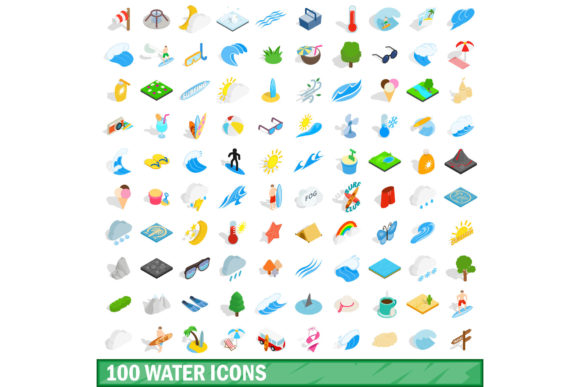
The core concept behind the 100 Water Icons Set, Isometric 3D Style is the application of isometric projection to fluid dynamics and aquatic elements. Unlike flat icons or photorealistic renderings, isometric illustrations provide a pseudo-3D look that maintains geometric precision. This style allows for depth perception without the complexity of perspective distortion, making it ideal for infographics, UI dashboards, and technical diagrams.
This specific set comprises one hundred distinct variations. These variations likely include natural bodies of water such as oceans, rivers, lakes, and waterfalls, alongside anthropogenic sources like taps, pipes, droplets, rain clouds, and swimming pools. By standardizing the angle (typically 30 degrees) and lighting direction across all 100 items, the set ensures that when mixed into a single composition, the result appears unified rather than disjointed.
Technical Specifications and Format Versatility
A critical factor in evaluating any vector asset is its file compatibility. The 100 Water Icons Set, Isometric 3D Style is distributed in multiple formats, including JPG, EPS, AI, PSD, and PNG. This multi-format approach significantly broadens its usability across different software ecosystems.
- AI and EPS: These native Adobe Illustrator formats are essential for scalability. They allow designers to edit paths, adjust colors, and modify shapes without losing resolution. This is crucial for print media where high-resolution output is mandatory.
- PSD: The Photoshop document format suggests the inclusion of layer structures. This enables users to isolate specific elements, apply custom textures, or manipulate shadows within a raster environment before exporting.
- PNG and JPG: Rasterized versions are optimized for web use. PNG files typically offer transparency support, which is vital for overlaying icons on various background colors, while JPG provides smaller file sizes for quick loading in digital interfaces.
Strategic Applications and Use Cases
Designers should consider the 100 Water Icons Set, Isometric 3D Style primarily when the project demands a modern, clean, and structured aesthetic. The isometric style has gained traction in recent years due to its ability to simplify complex data visualization.
Data Visualization and Infographics
When creating reports related to environmental science, hydrology, or resource management, standard charts can be visually dry. Incorporating these isometric water icons helps break up text-heavy sections. For instance, an infographic about global water usage could utilize the ocean, river, and tap icons to represent consumption categories, making the data more engaging and easier to digest.
User Interface (UI) and Web Design
In the context of web development, particularly for landing pages involving sustainability, travel, or wellness, these icons serve as effective visual anchors. The 3D effect adds a layer of sophistication that flat icons sometimes lack, drawing the user's eye without overwhelming the interface. Because the set includes 100 options, designers have ample choice to create unique navigation flows or feature grids.
Marketing and Branding Materials
Brands focused on hydration, purification, or eco-friendly initiatives often require imagery that conveys purity and clarity. The consistent lighting and shading of the isometric style project a professional and trustworthy image. Whether used on packaging, brochures, or social media campaigns, the uniformity of the set reinforces brand identity.
Evaluating Benefits and Tradeoffs
While the advantages of this asset pack are clear, a balanced evaluation requires acknowledging potential limitations and tradeoffs.
Key Benefits
- Cohesion: The primary advantage is the guaranteed visual harmony. Mixing individual icons from different sources often results in mismatched line weights, shadow angles, or color palettes. This set eliminates that risk.
- Scalability: With vector formats available, the icons can be resized from a mobile app icon to a billboard advertisement without pixelation.
- Variety: Having 100 distinct variations prevents monotony. Designers can select specific nuances, such as a gentle ripple versus a crashing wave, to match the tone of their content.
Considerations and Limitations
One consideration is the rigidity of the isometric style. If a project requires a whimsical, hand-drawn, or hyper-realistic look, this set may feel too rigid or technical. Additionally, while the vector formats allow for editing, the initial rendering might not perfectly match a specific brand's color palette without manual adjustment. Designers must be prepared to spend time recoloring the assets to ensure they meet strict brand guidelines.
Another factor is file size. While vector files are generally efficient, a package containing 100 high-quality isometric layers in PSD or AI format can be substantial. This may impact workflow speed if the designer needs to load the entire library at once.
Situational Fit and Alternatives
Determining whether to purchase or download this set depends heavily on the specific goals of the project.
When It Is a Strong Fit
This collection is an excellent choice for projects requiring a high volume of water-related imagery that must remain consistent. It is particularly suitable for:
- Corporate presentations requiring a modern, tech-forward look.
- Mobile applications where space is limited but visual appeal is high.
- Educational materials explaining water cycles or conservation.
When Alternatives May Be Worth Considering
If a project prioritizes artistic uniqueness over standardization, a bespoke illustration service might be more appropriate. Similarly, if the design language is strictly flat or minimalist, a set of 2D water icons would be more appropriate than the 3D isometric style provided here. Furthermore, if the budget is extremely tight and the project only requires a handful of images, purchasing a comprehensive 100-icon set might be an inefficient allocation of resources compared to buying a smaller, targeted bundle.
Practical Decision-Making Insights
To make an informed decision regarding the 100 Water Icons Set, Isometric 3D Style, designers should follow a simple evaluation process.
- Assess Volume Needs: Do you genuinely need 100 variations? If you only need five, check if a smaller subset is available to save costs.
- Review Software Compatibility: Ensure your team uses software capable of opening the preferred formats (e.g., if you rely on Sketch or Figma, verify how well the AI/EPS files convert).
- Test Editability: Open a sample file to see if the layers are organized logically. Well-structured files save hours of editing time.
- Check Licensing: Verify the usage rights. Some sets restrict commercial use or require attribution, which could impact your workflow.
Conclusion
The 100 Water Icons Set, Isometric 3D Style represents a robust solution for designers seeking to incorporate aquatic themes into their work with a modern, three-dimensional flair. Its strength lies in its consistency, versatility across file formats, and the sheer volume of options provided. While it may not suit every design aesthetic, specifically those favoring flat or organic styles, it excels in contexts demanding clarity, structure, and professional polish. By carefully weighing the benefits against the specific constraints of a project, designers can effectively leverage this asset to enhance their visual storytelling capabilities.