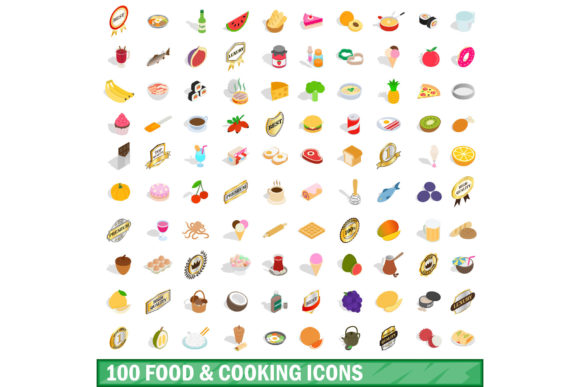
100 Food and Cooking Icons Set: A Practical Guide for Designers and Creators
In the fast-paced world of digital content creation, visual assets often serve as the bridge between a concept and its final execution. Whether you are designing a menu for a new restaurant, creating educational materials for a culinary school, or building an e-commerce platform for gourmet ingredients, the quality of your graphics directly impacts user engagement. This is where a comprehensive 100 Food and Cooking Icons Set becomes an indispensable tool in your workflow. It is not merely a collection of images; it is a strategic resource designed to streamline the creative process while ensuring visual consistency across various platforms.
Understanding the Asset: From Flat to Isometric
The core value of this specific icon library lies in its versatility and depth. The set includes two distinct stylistic approaches: traditional flat design icons and advanced isometric 3D style illustrations. This duality allows professionals to adapt their visual language based on the project's requirements without needing to source assets from multiple vendors. The flat icons offer clarity and simplicity, ideal for mobile interfaces, infographics, and navigation bars where space is at a premium. Conversely, the isometric 3D elements provide depth and realism, perfect for landing pages, promotional banners, and detailed product showcases that require a tactile feel.
When integrating these assets into a broader design system, understanding the distinction is crucial. Flat icons function best when paired with clean typography and ample white space, guiding the user through a logical path. The isometric versions, however, create a sense of immersion. They can be used to highlight key features, such as a "Chef's Special" or a "New Recipe," drawing the eye immediately to the most important information. By having both styles within a single 100 Food and Cooking Icons Set, designers maintain brand cohesion while having the flexibility to shift tones depending on the context.
Workflow Integration: Preparation and Planning
Effective implementation begins before the first file is opened. For professionals planning a project, the preparation phase involves defining the scope of visual communication. If you are developing a mobile application for recipe tracking, you might prioritize the flat icons for UI elements like "Search," "Favorites," and "Share." In contrast, if you are launching a website for a farm-to-table business, the isometric 3D icons could be the hero visuals that establish the brand's personality.
During the planning stage, consider how these icons interact with other resources. Are they being used alongside photography? Do they need to match a specific color palette derived from your brand guidelines? The 100 Food and Cooking Icons Set is typically available in formats that facilitate easy manipulation, allowing you to adjust colors to match your existing style guide. This compatibility ensures that the icons do not look like generic stock additions but rather integrated components of your unique design.
Organization is another critical factor in this phase. Before diving into the design software, categorize the icons based on their intended use. Create folders for categories such as "Ingredients," "Cooking Utensils," "Beverages," and "Kitchen Appliances." This pre-project organization saves significant time during the execution phase, reducing the cognitive load on the designer and allowing them to focus on layout and composition rather than asset hunting.
Execution: Utilizing Multiple File Formats
The technical specifications of the asset pack play a pivotal role in the efficiency of the execution phase. The availability of formats including JPG, EPS, AI, PSD, and PNG means that the set can be seamlessly integrated into almost any professional environment. Understanding which format to use at which stage of the project is essential for maintaining high-quality output.
- AI and EPS (Vector): These are the workhorses for the initial design phase. When working in Adobe Illustrator or similar vector-based tools, using the native .AI or .EPS files ensures that your graphics remain scalable. You can resize an icon from a small favicon to a massive billboard without losing any resolution. This is particularly important for responsive web design, where elements must adapt to various screen sizes.
- PSD (Photoshop): For designers who rely heavily on layering effects, textures, or complex compositing, the .PSD files are invaluable. They allow for non-destructive editing, enabling you to apply drop shadows, gradients, or blend modes to the isometric 3D elements to make them fit perfectly into a background scene.
- PNG and JPG: Once the design is finalized, exporting to raster formats is necessary for web deployment. High-resolution .PNG files with transparent backgrounds are ideal for overlaying icons onto different colored sections of a website or app. .JPGs may be used for final marketing materials where transparency is not required, offering smaller file sizes for faster loading times.
By leveraging the correct format for each step, you ensure that the final deliverables meet strict quality control standards. This attention to detail prevents common issues like pixelation or misaligned layers, which can undermine the professionalism of the final product.
Cross-Platform Consistency and Branding
In today's multi-channel marketing landscape, consistency is paramount. A brand presence that looks disjointed across a website, social media, and print materials fails to build trust. The 100 Food and Cooking Icons Set acts as a unifying element that ties these disparate channels together. Because the icons share a unified aesthetic, they create a visual rhythm that users subconsciously recognize.
Consider a scenario where a food blogger is expanding into a full-fledged business. They might start with blog posts featuring flat icons to categorize recipes. As they grow, they introduce isometric 3D icons for their merchandise page or newsletter headers. The transition feels natural because the visual language remains consistent, even as the complexity of the graphics increases. This scalability is a key advantage of investing in a comprehensive set rather than piecing together individual icons from various sources.
Furthermore, these assets support accessibility goals. Well-designed icons can convey meaning quickly, reducing the cognitive effort required to navigate a site. When combined with clear text labels, they enhance the user experience for all audiences, including those using screen readers or navigating in low-bandwidth environments. Ensuring that your icons are legible and intuitive is part of the ethical responsibility of modern design.
Collaboration and Long-Term Utility
For teams working collaboratively, the standardization provided by a dedicated icon set simplifies the handoff process. When a graphic designer passes a project to a developer or a copywriter, having a shared library of assets eliminates ambiguity. Everyone knows exactly which version of the "knife" or "oven" icon is being used, reducing the risk of errors and rework.
The long-term utility of this asset cannot be overstated. Creative projects often evolve over time. A menu updated next year might need new icons to reflect seasonal changes, or a marketing campaign might pivot to highlight a different cuisine. Having a robust library of 100 diverse icons ensures that future iterations of your work do not require starting from scratch. You can simply select the relevant icons from your existing collection, update the colors or composition, and deploy them rapidly.
This efficiency translates directly to cost savings and time management. Freelancers and small business owners, who often wear multiple hats, benefit immensely from having a go-to resource that minimizes the time spent searching for the right image. Instead of spending hours browsing stock photo sites or hiring illustrators for every minor change, they can utilize the 100 Food and Cooking Icons Set to maintain a high level of production quality with minimal overhead.
Conclusion: A Strategic Investment
Ultimately, the decision to incorporate a specialized asset like the 100 Food and Cooking Icons Set is a strategic one. It goes beyond aesthetics; it is about optimizing the entire lifecycle of a design project. From the initial planning stages where organization sets the tone, through the execution phase where format flexibility drives quality, to the final deployment where consistency builds brand trust, these icons serve as a foundational element.
Whether you are a seasoned agency director managing large-scale campaigns or a solo entrepreneur crafting a personal brand, the practical benefits of this set are clear. It empowers creators to focus on storytelling and strategy rather than getting bogged down by technical limitations or inconsistent visuals. By adopting a structured approach to asset integration, you ensure that your food and cooking-related projects are not only visually appealing but also efficient, scalable, and ready for the demands of the modern digital ecosystem.