3D Table Lamp Perfect for Design Project: A Comprehensive Evaluation for Professionals
In the rapidly evolving landscape of digital design, finding assets that seamlessly integrate into complex workflows is a constant challenge. The 3D table lamp perfect for design project has emerged as a versatile resource, offering a blend of realism and flexibility that traditional stock photography often fails to provide. This specific asset category is not merely a decorative image; it is a functional tool designed to enhance interior visualizations, furniture catalogs, and architectural renderings. By understanding its unique characteristics, file formats, and application scenarios, designers can make informed decisions about whether this resource aligns with their specific creative needs.
Defining the Asset and Its Core Characteristics
A 3D table lamp perfect for design project represents a high-fidelity digital model rather than a static photograph. These assets are typically generated using advanced rendering engines to simulate realistic lighting, material textures, and physical interactions. The distinct advantage lies in the editable nature of the source files. Unlike a standard JPG or PNG where the object is locked in place, these models allow professionals to manipulate angles, adjust light sources, change materials, and integrate the lamp into various environments without losing quality.
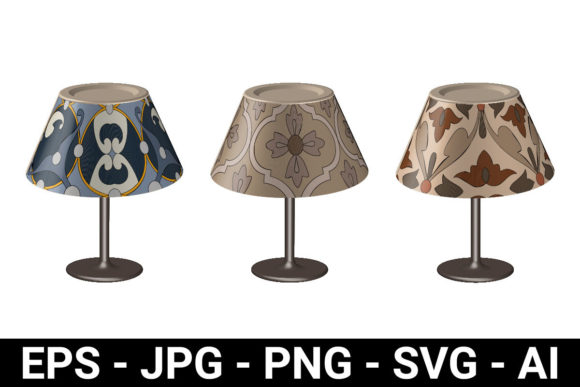
The collection usually includes a comprehensive suite of formats such as AI (Adobe Illustrator), EPS (Encapsulated PostScript), SVG (Scalable Vector Graphics), JPG, and PNG. This variety ensures compatibility across different software ecosystems. For instance, vector formats like SVG and EPS are ideal for graphic design tasks requiring infinite scalability, while raster formats like 4K renders are suited for photorealistic presentations. The inclusion of isolated elements allows the lamp to be placed against any background, making it an essential component for creating clean, modern illustrations of home and office spaces.
Comparing Formats: Vector vs. Raster Approaches
When evaluating a 3D table lamp perfect for design project, one must consider the tradeoffs between vector-based and raster-based workflows. The availability of both AI and EPS files alongside high-resolution renders provides a unique hybrid capability.
- Vector Formats (AI, EPS, SVG): These are superior for flat design styles, iconography, and branding materials. They ensure that the lamp remains crisp at any size, from a mobile app icon to a large billboard. If your project requires a minimalist aesthetic or involves integrating the lamp into a logo or UI element, the vector options within this package are indispensable. They allow for easy color manipulation, turning a white lamp black or changing the metal finish without pixelation.
- Raster Formats (JPG, PNG, Render): High-quality renders capture the nuance of shadows, reflections, and ambient occlusion. These are critical when the goal is photorealism. If you are designing a brochure for a furniture store or an architectural visualization for a client, the realistic texture of wood, metal, and glass found in the rendered versions is necessary. The "isolated" nature of these PNG files simplifies the compositing process, removing the need for tedious manual masking.
The decision often comes down to the intended output medium. A web designer might prioritize the lightweight SVG for fast loading times, whereas an interior architect would demand the high-bit-depth render for accurate material representation.
Integration into Interior and Product Design Workflows
The primary utility of this asset extends beyond simple decoration; it serves as a foundational element in spatial planning and product marketing. In the context of interior design, the lamp acts as a focal point that anchors a room's composition. Whether depicting a cozy apartment living room or a sleek corporate office, the ability to rotate and reposition the lamp helps designers test different lighting scenarios and spatial arrangements.
For furniture catalog creation, having a standardized lamp model allows brands to maintain consistency across multiple products. Instead of photographing every new desk setup with a different lamp, designers can use the same 3D table lamp perfect for design project to showcase various desk models. This approach reduces production costs and ensures that the focus remains on the primary product being sold. The asset's versatility supports concepts ranging from modern minimalism to industrial chic, depending on how the materials are adjusted.
Strengths, Limitations, and Decision Factors
While the 3D table lamp perfect for design project offers significant advantages, it is important to weigh these against potential limitations to determine if it is the right choice for your specific scenario.
Key Strengths
- Versatility: The inclusion of multiple file types (AI, EPS, SVG, JPG, PNG) means the asset can adapt to print, web, and 3D modeling projects.
- Realism: Advanced rendering techniques capture realistic lighting effects, including spotlights and bulb illumination, which add depth to 2D compositions.
- Efficiency: Pre-made, isolated objects save hours of modeling time. Designers do not need to build a lamp from scratch when the focus is on the surrounding environment.
- Customization: The ability to alter colors (white, black, wood tones) and materials (metal, plastic) allows for rapid prototyping of different design concepts.
Considerations and Tradeoffs
Despite its strengths, there are factors to consider before committing to this resource. First, while the vector files offer scalability, they may lack the photorealistic texture detail present in the high-resolution renders. If a project demands hyper-realism, relying solely on the vector version might result in a look that feels too "flat" or illustrative.
Secondly, compatibility issues can arise if the proprietary software used by a team cannot open specific versions of AI or EPS files. While generally compatible with industry standards, older systems might struggle with newer vector features. Additionally, the "perfect fit" depends on the style of the project. A highly stylized, abstract design might clash with a photorealistic lamp model, requiring additional texturing work to blend them naturally.
When to Choose This Resource Over Alternatives
Selecting the right asset often involves comparing it against alternatives like custom 3D modeling, purchasing individual stock photos, or using generic clip art. The 3D table lamp perfect for design project occupies a middle ground that offers the best balance of cost, quality, and flexibility for many professionals.
Choose this asset when:
- You need a high-quality object quickly without the time investment of building a 3D model from scratch.
- Your project requires both vector scalability and photorealistic rendering capabilities.
- You are working on interior design visualizations where lighting and material accuracy are paramount.
- You need to create variations of a scene (e.g., day vs. night, different furniture layouts) using the same core object.
Consider alternatives when:
- You require a completely unique, branded lamp design that does not exist in pre-made libraries.
- The project demands a specific, non-standard lighting interaction that the provided render engine cannot simulate.
- You are working on a low-budget project where even a single premium asset exceeds the allocated funds, and free, lower-quality options suffice.
Practical Applications in Modern Design
The applications for this resource are vast, spanning various industries. In architectural visualization, the lamp adds life to empty floor plans, helping clients visualize the scale and ambiance of a space. The "electric" and "illumination" aspects are crucial here, as the glow of the bulb can define the mood of a room.
In e-commerce, these assets are invaluable for creating lifestyle images. Instead of staging a physical photoshoot for every new chair or desk, marketers can place the 3D table lamp perfect for design project onto the product to show how it fits in a real-world setting. This accelerates time-to-market and allows for A/B testing of different room configurations.
Furthermore, the asset's suitability for digital illustration makes it a favorite for content creators. The clean lines and modern style of the lamp translate well into infographics, blog headers, and social media graphics. The ability to isolate the object on a transparent background (PNG) or edit the vector paths (AI) ensures that it integrates smoothly into diverse layout designs.
Making the Final Decision
Evaluating a 3D table lamp perfect for design project requires a clear understanding of your project's technical requirements and aesthetic goals. It is not a one-size-fits-all solution, but rather a powerful tool that excels when its specific capabilities are leveraged correctly. The combination of vector and raster formats, along with the realistic rendering quality, makes it a robust choice for professionals who value efficiency without compromising on visual fidelity.
Ultimately, the decision rests on the balance between customization and convenience. If your workflow benefits from having a high-quality, editable base object that can be adapted to multiple contexts, this resource offers significant value. However, if your project demands absolute uniqueness or highly specialized lighting simulations, further development or custom modeling may still be necessary. By carefully weighing these factors, designers can ensure that the chosen asset enhances rather than hinders their creative vision.