100 Statistics Icons Set: A Comprehensive Evaluation for Designers
In the landscape of data visualization and digital design, the clarity of information is often determined by the quality of its visual elements. The 100 Statistics Icons Set represents a curated collection of vector illustrations designed to simplify complex numerical data into easily digestible graphical symbols. This set includes two distinct variations: a standard flat or line-art style and an isometric 3D style. For professionals seeking to enhance dashboards, infographics, presentations, and web interfaces, understanding the specific capabilities and limitations of this asset bundle is essential before making a selection.
Understanding the Asset Composition
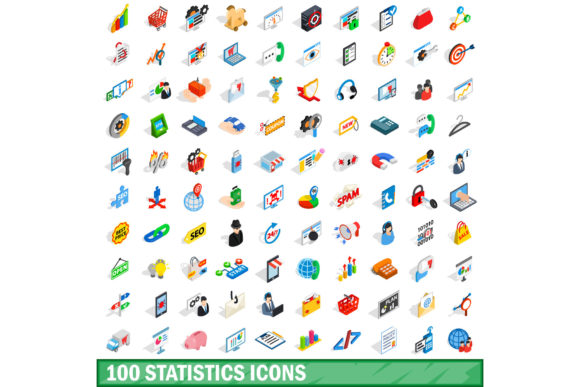
The core offering of the 100 Statistics Icons Set is a library containing one hundred unique icons. These are not merely decorative; they are functional tools intended to represent metrics such as growth trends, financial figures, user engagement, and analytical outcomes. The set is notable for providing versatility through its dual-format approach. Users can access the icons in a traditional 2D format, which is ideal for clean, minimalist interfaces, or switch to the 100 statistics icons set in isometric 3d style for designs requiring depth and dimensionality.
The technical specifications of this set are robust, catering to a wide range of software workflows. The files are available in multiple formats, including JPG, EPS, AI, PSD, and PNG. The inclusion of EPS and AI (Adobe Illustrator) files ensures that designers can scale the graphics infinitely without losing resolution, a critical requirement for print media and large-scale displays. Meanwhile, the availability of PSD (Photoshop) and PNG files supports raster-based editing and quick integration into web projects where vector manipulation is not required.
Strategic Applications and Use Cases
Designers and content creators typically turn to icon sets like this when they need to communicate quantitative data quickly. The primary use case involves creating infographics where text-heavy explanations would bore the audience. By replacing phrases like "increased sales by 20%" with a simple upward-trending arrow icon, the message becomes immediate and universally understood. The 100 Statistics Icons Set covers a broad spectrum of statistical concepts, from pie charts and bar graphs to target bulls-eyes and percentage indicators.
The isometric variation offers a specific aesthetic advantage. Isometric design creates a pseudo-3D effect that adds a layer of sophistication to a project. This style is particularly effective in:
- SaaS Dashboards: Modern software platforms often utilize isometric visuals to make data feel more interactive and engaging.
- Landing Pages: A section featuring isometric statistics can break up long blocks of text and draw the eye toward key performance indicators (KPIs).
- Presentation Decks: When presenting to stakeholders, 3D-style icons can add a dynamic element that keeps the audience visually stimulated.
Evaluating Benefits and Tradeoffs
When considering the acquisition of this set, it is important to weigh the benefits against potential tradeoffs. The most significant advantage is efficiency. Purchasing a pre-made set of 100 icons saves hours of manual drawing time. Instead of sketching individual charts or customizing vector paths from scratch, a designer can drag and drop these assets into their workflow. Furthermore, the consistency of the set ensures that all icons share the same stroke width, color palette, and perspective, maintaining a cohesive brand identity throughout a document.
However, there are considerations regarding customization. While the AI and EPS formats allow for modification, some users may find that the specific artistic style of the provided icons does not perfectly match their existing brand guidelines. If a company has a very strict, unique geometric style, adapting generic icons might require significant effort to align them correctly. Additionally, while the set includes JPG and PNG files, relying on raster formats for future scaling can be a limitation if the original vector source is lost or corrupted.
Decision-Making Framework for Selection
To determine if the 100 Statistics Icons Set aligns with your specific goals, you must evaluate your current project requirements. This asset is a strong fit for projects that demand a high volume of statistical representation within a short timeframe. It is particularly valuable for freelance designers working on tight deadlines who need reliable placeholders or final assets for client deliverables.
Conversely, this set may not be the optimal choice if your project requires highly specialized, niche data visualization that deviates significantly from standard statistical representations. For instance, if you are designing a scientific paper that requires a unique, non-standard graph type, a generic set of 100 icons might lack the necessary specificity. In such cases, hiring a custom illustrator or using data visualization libraries that generate code-based charts might be more appropriate.
Comparative Analysis of Styles
A critical decision point lies in choosing between the standard and isometric versions. The standard 2D style is generally safer for mobile applications and responsive web design, as it tends to render clearly at smaller sizes. The 100 statistics icons set in isometric 3d style, while visually striking, can sometimes become cluttered when scaled down too small. If your primary output is mobile-first, the 2D version should be prioritized. If the focus is on desktop viewing or print collateral, the isometric option provides a premium look that stands out.
Practical Integration Strategies
Once selected, integrating these icons effectively requires attention to detail. The file formats provided (EPS, AI, PSD, PNG, JPG) offer flexibility, but they serve different purposes. For the highest quality output, always work with the vector files (AI or EPS) during the design phase. This allows you to adjust colors to match your exact hex codes and resize elements without pixelation. Export to PNG only when preparing the final assets for web use, ensuring you select a transparent background to maintain layout integrity.
Organizing the set is also crucial for productivity. Since the collection contains 100 items, naming conventions and folder structures within your design software are vital. Grouping icons by category—such as "Finance," "Growth," "Users," and "Settings"—can streamline the selection process. This organizational step transforms the raw asset pack into a usable toolkit.
Final Considerations
The 100 Statistics Icons Set serves as a versatile foundation for data-driven design projects. Its strength lies in its variety, offering both 2D and isometric 3D perspectives across multiple file formats. While it may not replace the need for custom illustration in every scenario, it provides a cost-effective and time-saving solution for the majority of standard design needs. By carefully evaluating the balance between the speed of implementation and the need for brand-specific customization, designers can make an informed decision. Ultimately, the value of this set is realized when it is used to transform abstract numbers into clear, compelling visual narratives.